Match No. 354
Rhode Island Country Club
Fred Waterman & Bruce Monrad d. Ed Westfall & John Evans, 8 and 7
Fred Waterman & Bruce Monrad d. John Evans & Ed Westfall, 8 and 7
Rhode Island Country Club
Match Captain: Fred Waterman
How does one properly account for putts that just barely grabbed an edge of the cup and for bomb putts made? Skill or good fortune? This was no small question in Match #354, where they were the deciding factor.
It all began on Thursday night October 10, when the pairings were announced by our beloved Mr. Recorder: the highly papabile incoming Captain Fred Waterman and Bruce Monrad would take on John Evans and Ed Westfall. What a great group. The day would be wet and cold, but the wit of the Treasurer would be unfailingly dry and the kinship of the former Captain characteristically warm.
And what a treat for the former Recorder to play with his hero, Ed Westfall. Recall how some 50 years ago, Ed Westfall first came for dinner to the Monrad house at 91 Dean Road in Weston. Little Brucie Monrad was exiled across the street to the neighbors’ house at 90 Dean Road so that dinner would be Adults-Only. What was the 7-year old to do? Little Brucie and neighbor Peter Howe grabbed binoculars and spent the evening looking through windows of 90 Dean Road across the street into the windows of 91 Dean Road just to catch a glimpse of the star, Ed Westfall.
And the match? Friday dawned deeply overcast with rain threatening more liquidity than the Fed’s quantitative easing policy. But, while wet, the weather never got too bad.
“How many layers today, Fred?”
“I count 5!”
Our new Captain is known for coddling his back with ample layers of clothing. It might be gently pointed out, however, that the quantity of Fred’s layers is utterly at odds with his using a “carry bag”, which also coddles his back but has no serious pocketing available for all this clothing. By the time layers #1-#4 have been removed, Fred’s golf bag has all that clothing hanging from the handle and looks like the Joad family vehicle in “The Grapes of Wrath”. (This Man of Numbers will make no further snarky remarks regarding the Man of Letters’ back, because he spent the entire day being carried upon it. The sun didn’t shine at RICC, but Fred Waterman did. On that soggy day, Fred showed off the “water” part in “Frederick Waters Waterman” (sic) and hit fairway after fairway with his tee shots.)
A very generous give by Westfall/Evans on #1 for AS, and we were off to the rest of the course in the rhythm of our cherished foursomes format.
On the 7th, the former Recorder found himself on the edge of the bunker. “Just advance it somewhere,” prudently advised Waterman. “Point of Parliamentary Procedure!”: Does it count as “advance” if Waterman had to hit the next shot from, yes, one yard forward……but from 45 yards to the right…..and from under a bush?
But back to the original question, how should one view the multitude of improbably made putts by the Monrad/Waterman side? (Hint: the former Recorder couldn’t even manage a lip out from a trifling 3 feet on the 5th hole. QED.)
To start, the elements were a great equalizer, because rain slows greens, and thereby increase the velocity window for a putter to make a putt. See the Appendix, or just think about it: a guy like Ed Westfall is known for his expertise on ice surfaces, with Stimp rating probably like >50 and a high degree of precision required. The guy would make a puck stop just before reaching the icing line on a regulation 200-foot NHL rink. At the other extreme, your Master of the Lie can maybe navigate green speeds as well as Ed Westfall only when there is standing water on a green for a Stimp rating of <1 foot. (BTW, we could see putt lines through the moisture at RICC, which was fun).
Several putts made by the team of Waterman & Monrad proved decisive, nearly all of which all fell from either the “three o’clock” or “nine o’clock” position on the hole. Add to that the outrageous and implausible 54’ length of one throw of the dice.
Waterman’s precision driving and his partner’s putting good fortune would bless their team throughout the remainder of the day. They sprinted out to a big lead, to the point where a 7-down Ed Westfall paused on Nayatt Road, looked at the heavens and offered the thanatopsis: “Maybe if I just stay here, a car will come and hit me”.
Alas, that was but a ruse, and woe to Waterman & Monrad if they started measuring Westfall & Evans for their caskets at this point: As the Chinese wisely teach us: qui hou suan zhang — we will balance the books only after the autumn harvest. Westfall & Evans promptly won 3 out of 4 of the remaining holes in the AM and cut the once comfortable lead in half as we went into lunch at 11:20 AM (to consume of the outstanding RICC Bloody Marys that Pen White suggested during our last visit here and which we both remarked upon the night before).
And the lunch? Could have been the best ever, with everyone riveted in their seats until 2PM. The luncheon match updates were absolutely riotous. And there was the new Captain in the Captain’s Chair, generously given to us by the Willow Warblers.
During the afternoon, the lead narrowed further and then extended a bit. The match ended on #13, perilously close to Nayatt Road and the location at which Waterman & Monrad knew that Evans & Westfall would be able to turn it around again. Phew.
A wonderful day. Huge thanks to our officers: John Nesbitt for his thoughtful leadership as Captain; Mr. Recorder for his extraordinary efforts on behalf of us all; and congratulations to the new Captain who is such a welcome choice. The Society is in good hands. Thanks also to Rich Powers and RICC for letting us play on their course, notwithstanding the elements. For the record, I did my part not to make Fred take big fairway divots, and I hope that was appreciated.
Respectfully submitted,
Bruce Monrad
Magister Mendacii
Appendix
It is with considerable trepidation that the following Appendix is submitted. After all, one DMS officer formerly worked in the USGA headquarters, where they mathematically analyzed swings using “Iron Byron”, and he famously knows that every well-struck golf ball will spend precisely 5.5 seconds in the air. And one Former Captain was both a graduate from MIT and such a genius at the card tables of Las Vegas that they made a movie about him. But, even though this writer is thus well out over his skis on this one, let’s tiptoe forward and see what we can say about “lip-ins” of the variety that so dominated Match #354 Skill or good fortune?:
To start, let’s stipulate that: a golf ball will drop into the hole only if the equator of the ball has fallen below the back lip of the cup before impact with that lip. Otherwise it will hit the back lip and its forward velocity will tip it forward and beyond the hole.
Question: what is, accordingly, the maximum terminal velocity v(f) below which an on-center putt must be traveling when it reaches the front lip of a hole in order to drop? We can use:
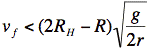
Gravity (g) at 9.80665 m/sec2 means the downward velocity and downward distance of a falling putt on increases with time. This is captured by the above formula, in which R(H) is the radius of the hole, R the radius of the ball. Since the radii of both the hole and the ball are known, v(f) < 1.31 m/sec. for on-center putts to drop.
However, for a putt that is off-center, the “back lip” is reached sooner than for a putt in the center of the cup (i.e. R(H) decreases), and so the terminal velocity that allows the hole to capture the putt is reduced accordingly in that case. By definition, a putt on the extreme left or right side lip of a hole – precisely the sort that swayed Match #356 — will reach its associated “back lip” instantaneously and, therefore, must be travelling imperceptibly slowly forward in order to give gravity the time to make the ball fall into the cup and not lip out. A phenomenally narrow window of opportunity! (George Ticknor, check here ___ if you’re still reading. Sure, you might have gotten a Summa on your senior history thesis, but are you still with us?)
Shifting to that unlikely 54’ putt on #13, how large was the window for the initial velocity of a successful putt off the club face? With gravity fixed, the window also effectively varies negatively with increasing green speed or its proxy, p(g). In short, while Ed Westfall can get the distance right on 200 feet of ice, it’s a miracle when any of the rest of us can get the distance right on 54 feet of wet grass.

(Reference: http://large.stanford.edu/courses/2007/ph210/kolkowitz2/)
(See also: “Fraud includes the pretense of knowledge where knowledge there is none.” B. Cardozo, Chief Judge, in Ultramares v Touche, 1931.)