Meeting minutes
2024 Captains' Grand Tour
The plan was audacious: two weeks, three countries, ten courses, and fourteen members of The Dinner Match Society. Could it really be pulled off?
A duty of every TDMS captain is to arrange a tour, but the Covid pandemic had prevented former captain Fred Waterman from arranging the trip he had planned for 2021 (Southeast England then the London-Edinburgh train and time in Gullane and St. Andrews), and Captain Scott Essex needed to arrange a memorable journey, so they decided to combine their obligations into one grand tour. But, to where?
The first try was a Northern Ireland/Scotland/England troika. E-mails were sent and calls were made. Nope, that wasn’t going to work. Member-only days, spring meetings, tee-time limitations … Northern Ireland (ah, Royal County Down would have been a pleasure) and St. Andrews were crossed off.
Okay, next up — the west coast of Scotland and England. Much more promising.
“Have you thought of Western Gailes and Prestwick?” asked tour advisor Gordon Simmonds.
“Would those be possible?”
“Let me see,” he replied.
Fourteen seconds later: “Yes, they would,” Gordon said.
Well, what about Hoylake? “Done!” said Kieran O’Brien.
That was easy.
Where to next?
Royal Birkdale. Yes, that would be good. But, no chance of playing with members…? Rats. Tee times are elusive, but a conversation with the general manager about TDMS, golf history, and Brookline’s 2022 U.S. Open … and two times are found on a possible day.
Royal Lytham & St. Annes Golf Club (named after the two local towns, “Lytham” and “St. Annes”) would be wonderful, but logistical obstacles keep cropping up. A long tour is like lining up dominoes, and if one falls anywhere, they will all fall. Lytham will eventually be replaced by Blackwell, south of Birmingham, a small, friendly club, cleverly folded into less than 100 acres. Nigel Theyer knows everyone. Arrangements are made. Brilliant!
Where next? Rye and Royal St. George’s…how could we miss those gems??
Then on to France…luxury, decadence and golf at Morfontaine and St. Germain…!
And so it began on May 16th, the TDMS crew met on the western coast of Scotland to commence the 2024 Captains’ Grant Tour. Immediate past Captain Fred Waterman and Captain Scott Essex led an alternating crew of 14 TDMS members and one guest, over 13 days, across three countries at nine majestic European golf courses (didn’t we say ten??? We’ll get to that later). The Tour travelers, which peaked at 8 and troughed at 4, included: Newcomb Cole III, John Reinman, Fred Waterman, Gordon Simmonds, Sandy Anstey, Dave Power, Kieran O’Brien, Nigel Theyer, Richard Fisher, Ben Colburn, George Ticknor, Briggs Kilborne, Mark Taylor, Scott Essex & Hunter Essex.
The journey began at Western Gailes, where we were hosted by Andrew Biggert and a group of members for lunch and golf on a lovely, rolling seaside links course. The tour participants were blessed with warm sun and light, variable breezes – conditions that sustained throughout the first week of the UK portion of the tour.

(Western Gailes par-3, 7th hole)
We progressed south to Prestwick, where the tour played morning foursomes versus the Prestwick membership. We paused for a magical lunch, reputed to be the best lunch in golf and it would be hard to imagine a finer dining experience in golf. We were joined at lunch be Sandy Anstey who rotated in to compete in the afternoon leg of our foursomes matches. After pints on the terrace, our host, Gordon Simmonds led the Prestwick and TDMS players to the “Rouge” Lion pub for a few libations followed by a spicy curry at the local Indian restaurant in Aryshire.

(Newcomb sharing a pint with a Scottish lass (photo bomb, complements of Waterman and Reinman)):

(Prestwick # 17: oldest hole in golf)

(TDMS crew in front of Prestwick 18th green)
After two evenings at the Marine Troon Hotel, adjacent to Royal Troon Golf Club (host of the this year’s Open Championships), the tour motored its way from Ayeshire, Scotland down the western edge of Scotland to Wirral, England, the home of Royal Liverpool (Hoylake).

(Hoylake Clubhouse)
We were joined at Liverpool by Nigel Theyer, Richard Fisher and Dave Power. There, our host, Kieran O’Brien arranged for accommodations in the homes of local members, which made the experience there all the more special. Our first evening, the Hoylake members hosted the tour for a formal dinner at the club. We partook in various post-dinner traditions, including an indoor chipping contest up the club house stairs! Our goal being to chip a ball up six steps, with the goal being to land the ball as close to the top of steps. Hitting the back wall, some ten paces from the top step resulted in disqualification from the contest.

Our local hosts were beyond gracious and their hospitality exceptional. TDMS members stayed in the homes of Kieran O’Brien, his son-in-law, Tudor Williams, Nick Moss and Mike Johnson. The following morning, we played a wonderful foursome match versus Hoylake members in warm, sunny, windless conditions, yes, you heard that right. We paused for a wonderful lunch, in a private room reserved for members, where we shared match reports, shots of the morning and a gloriously prepared lunch.

(Private members dining room at Hoylake)
Following our lengthy lunch, the group headed back out, full from the fine food and limber from wine, to the course to play in a friendly 8-some fun round.
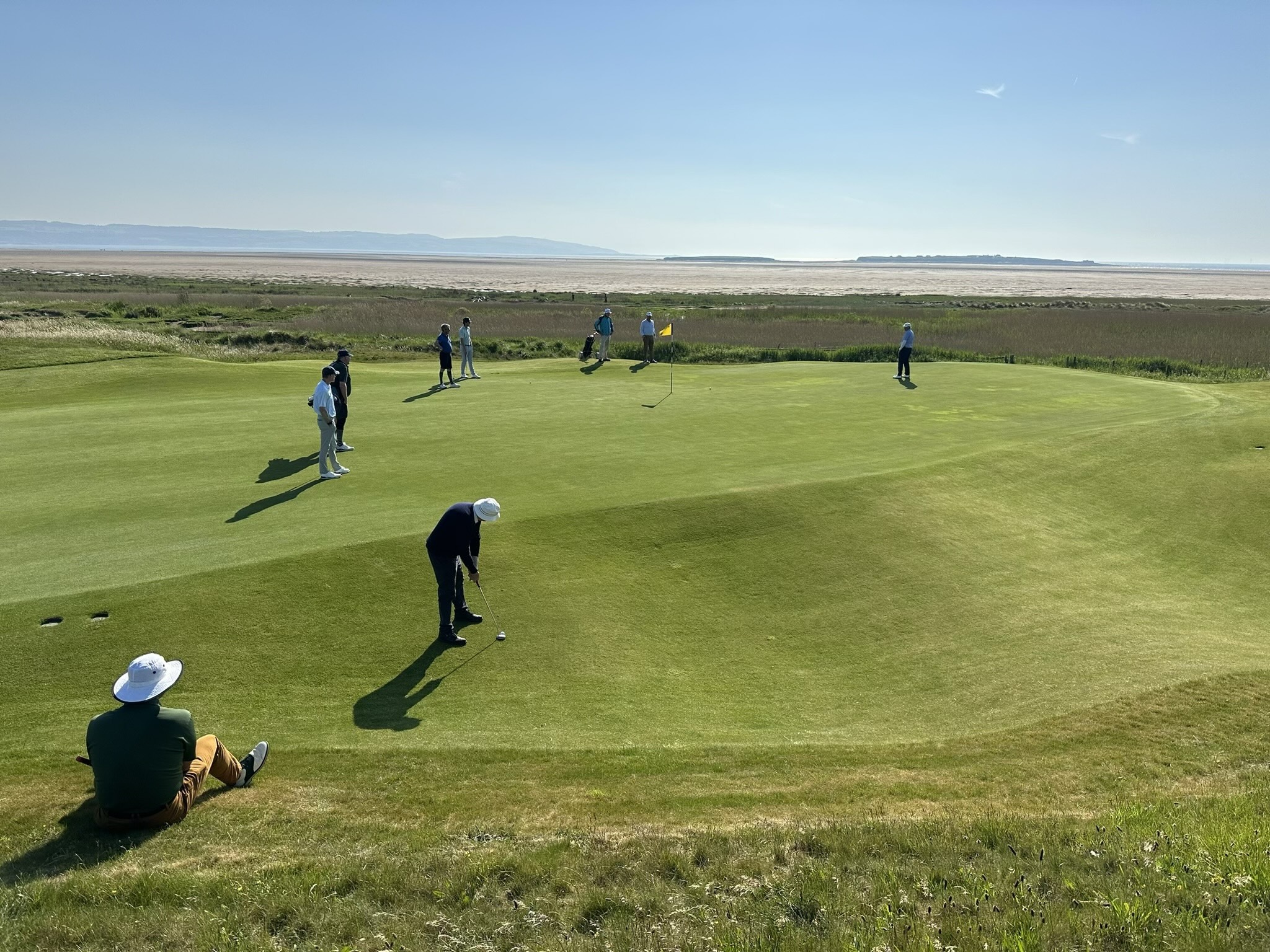
(Nine-some on the Alps at Hoylake)
The day concluded with drinks on the back terrace, where several TDMS members were relegated to an outside barrier to enjoy their cigars.

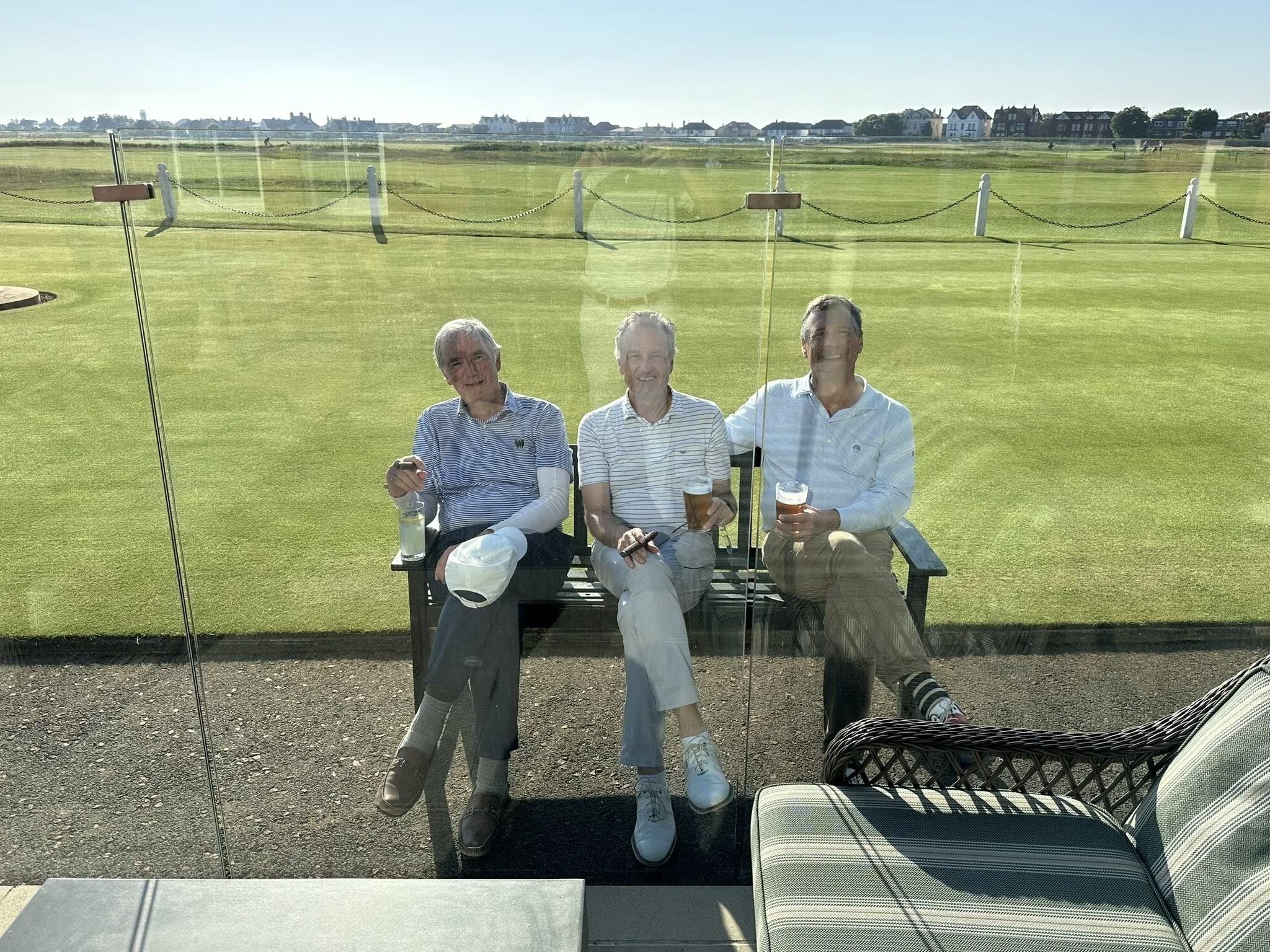
(Hoylake back terrace)
The tour moved on from Hoylake, going north up to Royal Birkdale, where we met Mike Burns, who led us on a comprehensive tour of the club and shared a member’s insights into the deep history of the club in the game of golf. Playing host to ten Open Championships, the most recent being the 2017 Open Championships, where Jordan Spieth put on a tantalizing Sunday performance to win the Claret Jug.

(Birkdale Par-3, 7th hole)

(TDMS crew at Royal Birkdale)
There was high demand and many players playing the course that day. After lunch with Mike, the crew played in two three ball teams, finishing the 18th hole as a TDMS tour 6-some after 8:30pm local time. From there we took a long van ride down to Blackwell.
Blackwell is truly a diamond in the “rough” – a gorgeous inland golf course, with immaculate, tree-lined fairways and fast, sloped greens all packaged neatly into 102 acres of land. Our hosts, Ashley Cox and Martin Fitzpatrick (both of whom were guests at our TDMS meeting at Rhode Island CC in the fall of 2018) shared much about the course’s history and place in golf lore, including Walter Hagen’s competition with Archie Compston in 1929 after winning the Open Championship at Muirfield. After a light lunch, the tour played foursomes 18 holes with Ashley and Martin, who led our six-man crew around the course, a tour of the club, including the “spike room” and a light lunch.
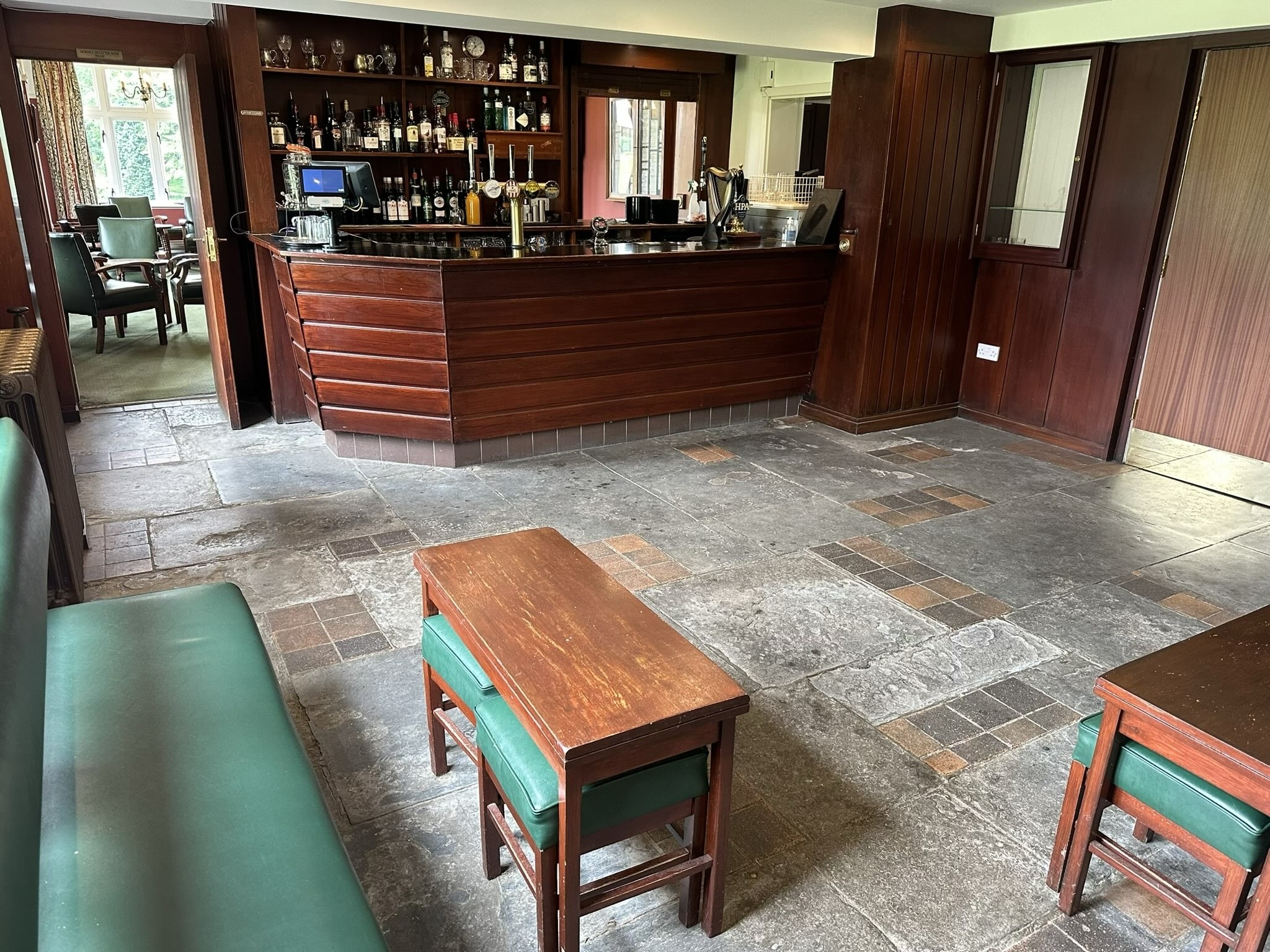
(Spike Room Blackwell GC)
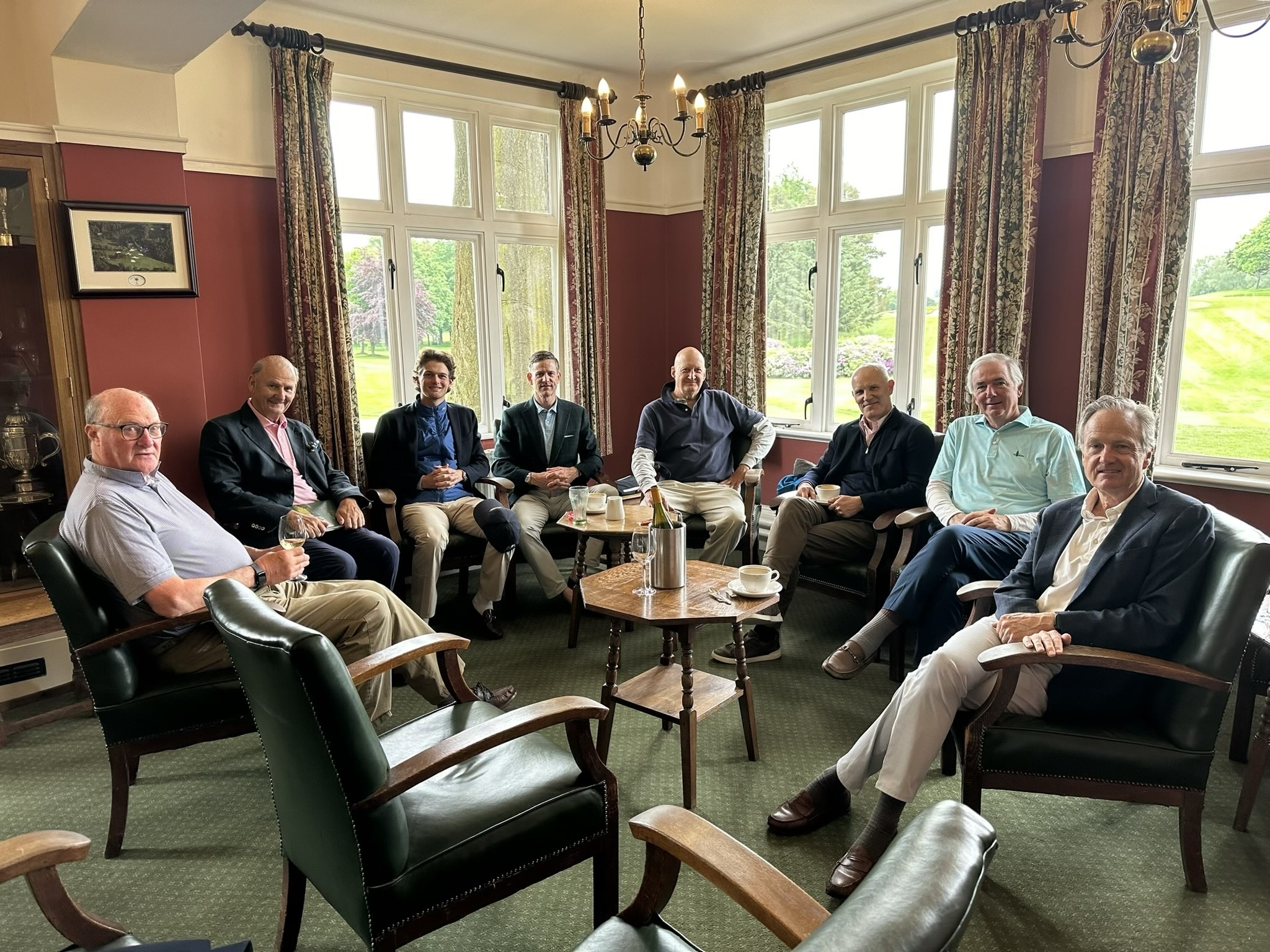
(Light lunch at Blackwell)

(TDMS crew at Blackwell GC)
Subsequently, the Tour made it way southeast via London, with members rotating out and others in. After a hasty and jumbled transition from sprinter van to SUV, Ben Colburn, George Ticknor, John Reinman and Fred Waterman went on to play Rye and Royal St. George’s… But before we go to the eastern coast of England, we must first discuss France…
“I think we have all really adapted well to the ‘chateau life,’” said George Ticknor, raising his glass in a toast to his fellow TDMS travelers.
Ben Colburn, Mark Taylor, Fred Waterman, and “Cousin Briggs” Kilborne raised their glasses in agreement. “To the ‘chateau life,’” they chorused and took another sip (well, perhaps much more than a sip) of the fine French red wine they had been savoring since arriving in the little, old town of Senlis. From the mantlepiece behind Ticknor, an oil painting of chateau owner Chris Burch smiled down at the final five members of The Dinner Match Society’s 2024 Captains’ Grand Tour.

(Chateau Life… )
A golf trip can officially be declared a success when the tourists vote not to play more golf, and this is what happens when your lodgings outside of Paris are a chateau built in 1608 and renovated over eight years by a billionaire entrepreneur.
At TDMS’s 2023 fall dinner, after plans for the Captains’ tour were announced, Michael Kane asked co-organizer Waterman whether there would be interest in staying at a four-century-old chateau not far from Golf de Mortefontaine (often described as the finest course on the European continent). The offer was accepted with humility, gratitude, and alacrity. Michael said he had not yet been to the chateau (featured in Architectural Digest, the April 2019 issue) but he looked forward to joining us there.
So, the plan was made. The biggest problem, as it turned out, was getting to France, but that is jumping ahead. First the backstory…
Through the first five stops of the Captains’ tour, players had been swapped in and out like a WWE tag-team wrestling match, and the second half of the tour would feature more of the same. On the evening of Tuesday, May 21, the SUV taxi traveling from Blackwell Golf Club in central England (just south of Birmingham) arrived at London’s St. Pancras railroad station and spilled out Captain Scott Essex, his son Hunter, Dave Power, John Reinman, and Waterman. Waiting for them was Colburn at the wheel of another SUV, one that because of its immovable seats ended up as a clown car with Power and Reinman disappearing like Fortunato in “A Cask of Amontillado,” but sealed off behind a wall of golf clubs and luggage. Nearly two hours later, after cries of “Mr. Gorbachev, tear down this wall!” their re-enactment of the early Gemini space capsules ended in Sandwich where a private house, owned by a member of Royal St. George’s, had been rented, and George Ticknor awaited, ready to join the tour.
RSG, built in 1887 in southeast England’s “wild duneland,” was the first course outside of Scotland to host an Open (1894) and has hosted a total of 15, with Collin Morikawa winning the most recent one, in 2021. The fairways are undulating and unpredictable, there is often plenty of wind off the sea, and no adjacent fairways; RSG is a test. In Goldfinger, James Bond played Auric Goldfinger at “Royal St. Marks”; the described course is actually Royal St. George’s, where Ian Fleming was the captain-elect when he died in 1964.

(RSG…storm brewing on 13th)
Our organizing host at RSG was TDMS member Tim Yeo, who was a member of Parliament for 32 years, served as Secretary of the Environment and Countryside, is currently writing the excellent golf column Only Friends You Haven’t Met Yet, and is the father of famed portrait painter Jonathan Yeo, who did the recent red-dominant painting of King Charles. If you ever need someone to arrange a perfect tour visit, Tim is the man. We played 36-hole matches with amiable members, the day’s three meals were all taken at the club, wines at lunch were graciously covered by absentee member Bruce Monrad (perhaps embarrassed that he was not present to join us), and dinner with our opponents and other guests was a joy.

(RSG match)
Reinman later wrote: “To me the spelling says it all: it's not plural, it's possessive. The singular Royal St. George's Golf Club sandwiched between Margate and Dover is one-of-a-kind, as was the hospitality accorded to us. And while members understandably might be possessive about this haven where so much history has unfolded, our hosts in fact freely shared with us some generous hospitality. Not even a 7&6 beating administered to Ben Colburn and me could dim the thrill of walking its fairways. And, oh yes, some rough. The only rain of the tour’s first week pelted us as we walked in from the halfway hut, intent on finding friendlier liquid inside its storied clubhouse.”
The tourists' post-dinner conversation focused on how soon the next visit to Sandwich should be arranged: two years was the agreed-upon answer.

(TDMS crew at RSG)

(photo of menu)
The next day, after saying good-bye to the owner and proprietor of the John Reinman School of Good Smokes, the team of Power, Colburn, Ticknor, and Waterman continued on to Rye. Bernard Darwin (1876-1961), raised by his grandfather Charles Darwin, trained as a lawyer, but his heart wasn’t in it, and he became golf’s most revered writer. Twice captain of Rye, Darwin said of the course, “There are few lovelier views than Rye perched on its hilltop like a fairy citadel in the sunset.” The Germans did not share Darwin’s reverence, and during World War II dropped a bomb on the clubhouse.
A course was first laid out on this terrain in 1894 by Harry Colt; in 1932, Tom Simpson did a re-design; and Alister Mackenzie afterward suggested some adjustments.

(Rye hosts and TDMS crew)
Pugwash’s good friend Chris Stephenson welcomed us with wonderful teammates and. after a kümmel-infused lunch, we played a course that, afterward, if it had been a woman, Dave Power would have brought her flowers, chocolates, and pledged undying love. Later, Power described Rye as "a remote and understated golf club” providing a round that is "both reasonable and nearly impossible. The enchanting seaside terrain, massive dunes, unexpected bunkers and strong winds lead you to wonder if you will run into a Hobbit. Its passionate members, railroad ties to prevent putting from off the green, and insistence on two balls per group contribute to its personality as a quirky and not-to-be-missed golfing experience.”

(“Goal posts” for the long second shot on 13th hole at Rye)
Dinner was our thank-you gift to our hosts’ generosity (the bill fort our lunches and green fees had vanished), then we were welcomed at Stevo’s house for the night. As we left, the conversation was centered on when Rye’s team would come to America.
Now, regarding that problem about getting to France…
More than 40 ships a day travel between Dover/Folkestone and Calais, but due to Brexit, only one each day takes foot-passengers in the morning, and this ship is sold out months in advance. So, how were we to get there? And France was right there, in sight! Should we fly? But, from where? And surely too expensive. Train back to London, then London to Paris, then more trains to play at Le Touquet (on the northwest coast of France). Nope, that was silly. Take the car-train? Rental cars had to be returned to the same country. Rent a boat? None easily found. Six weeks study of timetables, options, small print, etc., had produced nothing. Would TDMS’s Captains’ Grand Tour end ignominiously in the shadow of the white cliffs of Dover? It looked that way until someone suggested … brace yourself … “Take a taxi.” (Sound of a needle scratching across a phonograph record.)
Yes, a taxi.
Pets are not allowed on many cross-Channel conveyances, so the devoted pet owner hires a taxi to take the car-train under the Channel and deliver Fido, Pussy, or Iggy the Iguana to French or English soil.
Ed’s Taxi — at your service. Voilà!
Welcome to France.
Golf at Le Touquet did not pan out — our intended host, a friend of the Greenwood family, had a family emergency. Power departed the tour that morning to meet his wife in London, leaving Waterman, Ticknor, and Colburn, who headed to Senlis, situated 25 miles north/northeast of Paris.
Mark Taylor, who had just spent weeks in Italy with his family, had already arrived at the chateau, with its 14-foot walls (meant to keep out the rabble in past centuries — and perhaps the present). The enclosed photographs tell you most of what you need to know; the chateau is more than 10,000 square feet and when you count bedrooms, you easily reach double-digits.

(Chateau bedroom)
The chateau, at the address 24 Gérard de Nerval, is where France’s Louis XVIII spent a night in 1815; where the Nazis took up residence during World War II; where Eisenhower spent time after the war; and where the singer Sting and his wife spent part of the Covid pandemic and he recorded part of his album The Bridge (though not in the 13th-century columned crypt just inside the gates).
We arrived on Friday evening, were joined a few hours later by Cousin Briggs, and on Saturday morning began the soon-to-be-beloved daily routine of making the seven-minute walk into Senlis’ town center, buying croissants at the best boulangerie, then sitting in a sidewalk café and enjoying café au lait, café Americano, etc., while watching the town come alive in the morning. Anyone interested in golf today? “No!” On Sunday morning … Anyone interested in golf today? “No!” Lunch was cheeses and wine, the afternoons featured naps, and each evening required a choice of restaurants. Brutal. And Michael Kane? Unavailable. His presence was requested at home. By e-mail, he beseeched us to be good and thankful guests so that he would still be invited to the chateau.
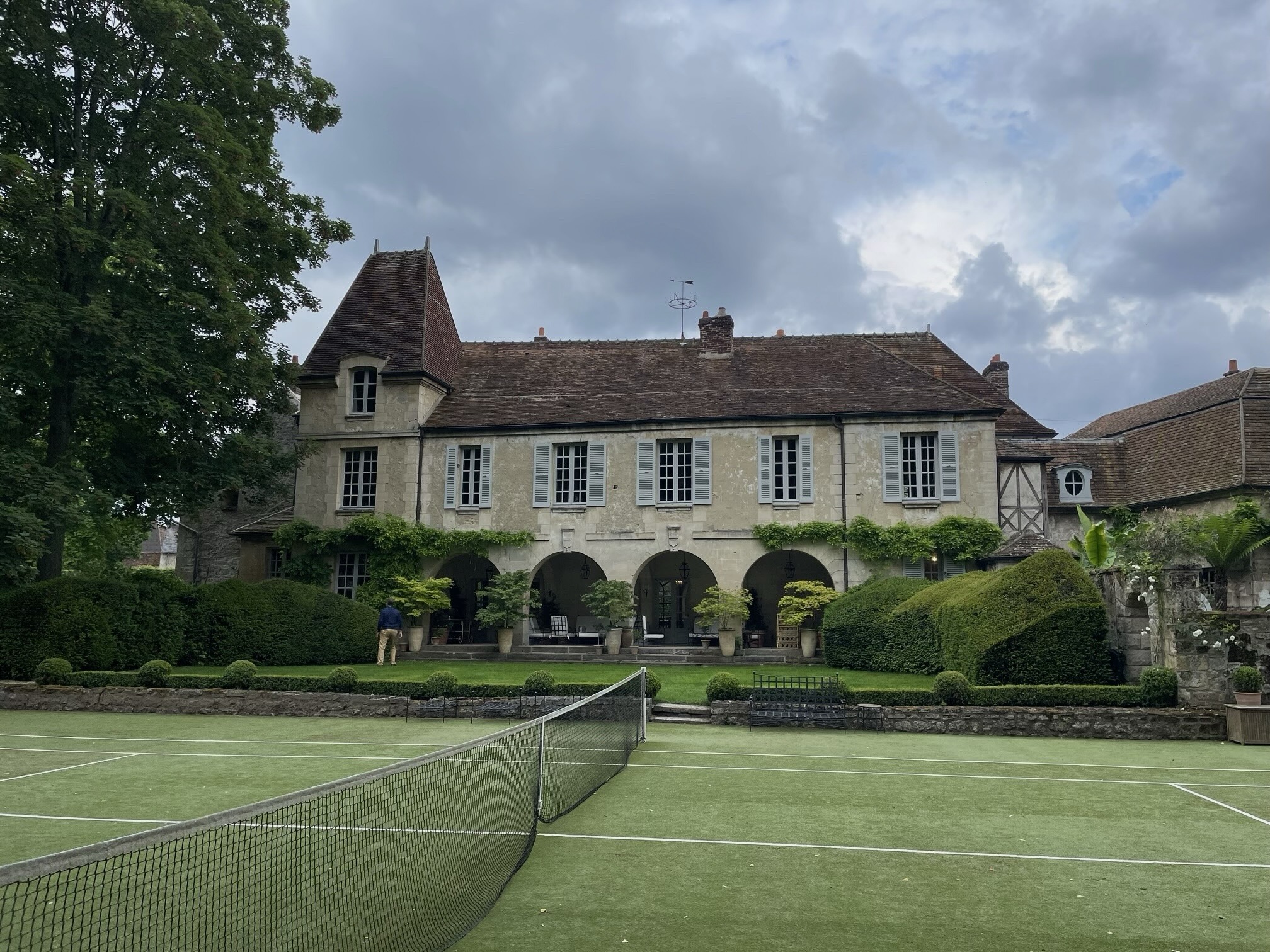
(Chateau tennis court)
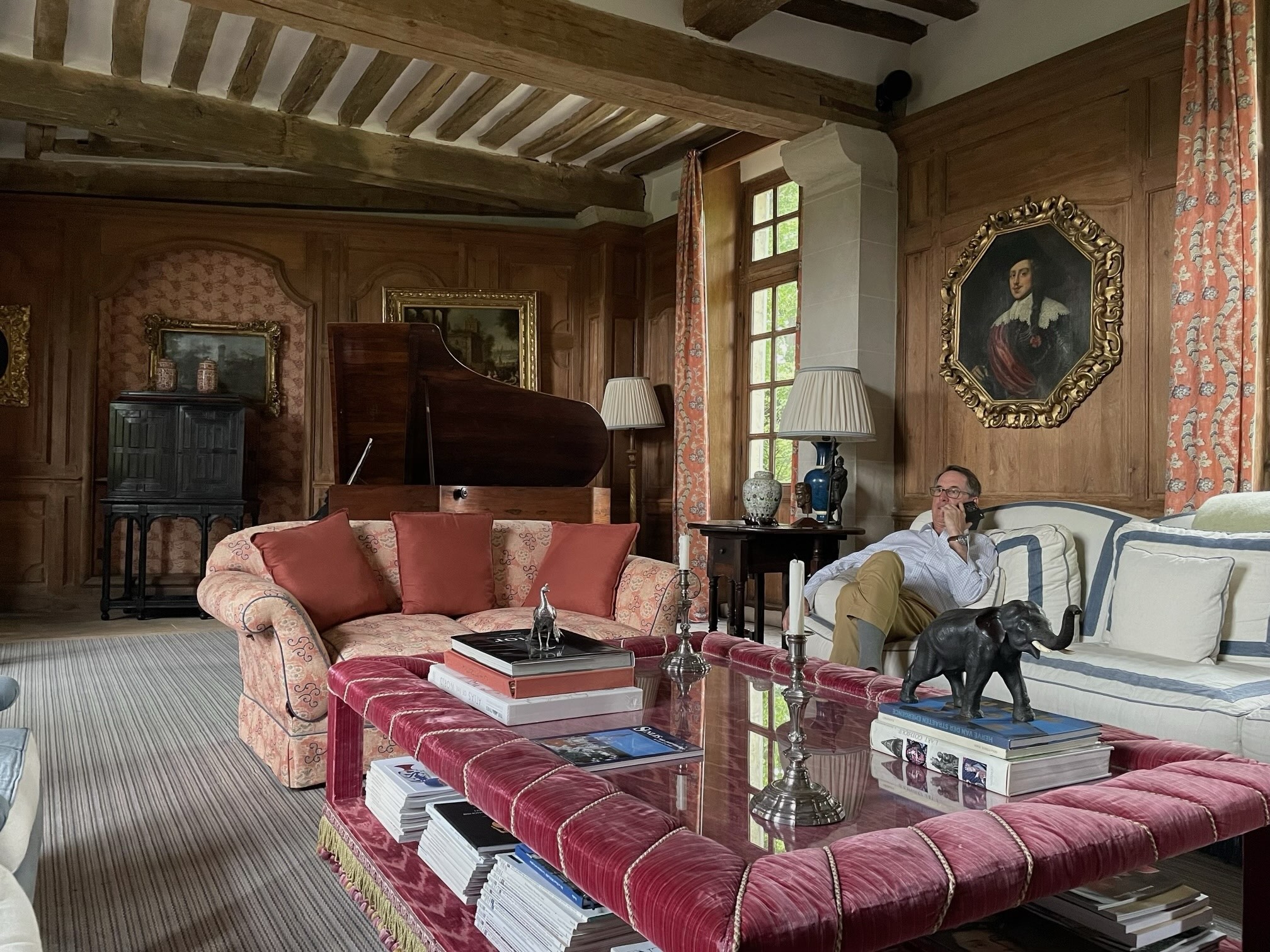
(Colburn at ease)
Monday was our round at Golf de Morfontaine (though the town is “Mortefontaine”), with members, a match graciously arranged by Greg Meahl, a member of TDMS and Morfontaine, in coordination with Alec de Lezardiere. Ben Colburn later wrote that we drove down “a small country lane only to be faced with a daunting security gate requiring a ‘communiqué en français’ to gain entry, resulting in a desperate attempt to pronounce our host’s name with some semblance of a Parisian accent. Mission [barely] accomplished, we headed into a deep wood, half-expecting les cerfs or les sangliers [deer or wild boars] to burst out of the ferns at any moment. Soon, we caught glimpses of the emerald green of a rolling woodland course (designed by Englishman Tom Simpson in 1927) and our destination hove into view, perched atop a small knoll: a welcoming, hunting lodge-like clubhouse. Warmly greeted by our hosts, we fortified ourselves with an expresso [the correct French spelling] at the bar, and Fred and Alec created teams for our morning matches.”

(Morfontaine hosts and TDMS crew)
After seven holes, Waterman told his opponent, Basile Schlumberger, that it was time for the visitor to “put down the hammer,” but then immediately lost the eighth hole. While walking to No. 9, Basile, in mock innocence, asked, “Now, what ees thes about a hammair?”
Colburn, in a 1 versus 2 match, was surprised to hear one of his opponents respond to a shot with an angry string of words that were clearly not descriptions of Monet’s “Water Lilies”; Colburn’s other opponent, who had spent time in Brazil, explained that Colburn had just heard remarkably colorful Portuguese gutter slang (no translation was not provided).
Regarding lunch .. well, we were in France, so it was magnificent: wines, steak tartare, and the Morfontaine’s last bottle of Wolfschmidt’s kűmmel (note photo).
In the afternoon, we played a five-ball tensome, which the bemused French immediately embraced. Colburn wrote: “The teams battled mightily for skins in the form of Morfontaine logo golf balls. At one point, so fiercely were these skins/balls contested, two of our hosts heatedly argued in colorful French (which did not hold a candle to gutter Portuguese) over the necessity of a putt relative to the other four scores. Clearly, Les Françaises were ‘all in.’ With two holes remaining, the heavens opened, but the contestants continued on, and the last two skins/four balls were earned on 18 in a deluge. Despite the soaking, all involved had a tremendous day on Simpson’s parkland masterpiece that undulated through pines and ferns, one picturesque hole after another, featuring blind shots, dramatic bunkers, and slick greens.”
Good news for The Dinner Match Society. We are now welcome at Morfontaine; a beachhead has been established.
On Tuesday, while George, Ben, and Mark were on their way to the airport, Cousin Briggs played Golf de Chantilly Vineuil solo (the course was originally believed to be unavailable to us, but one of our Morfontaine hosts, Emmanuel Schlumberger, also belongs to Chantilly; a phone call was made, and "Le Cousin Briggs” was welcomed).
Originally designed by J.H. Taylor and opened in 1909, the club, on the grounds of the Château de Chantilly, hosted the French Open just four years later and nine more times by 1990. Tom Simpson (of course), did some redesign work in 1920.
Briggs wrote that he was intrigued by Chantilly’s square greens, also the bunkers that you never stepped down into, instead, you never broke stride as you walked straight in, on level ground, then the bunkers rise up ahead of you. “And the final three holes featured a deep gulley that required an approach shot over it to reach the 16th green, then on 17 you have a tee shot where the green is way down on the other side of the gulch — it felt like 100 ft. down, then after 17, you climb up to the No. 18 tee box to hit a long tee shot over the gulch to get to the last fairway. Not for a novice golfer. Quite intimidating.”

(Chantilly, clubhouse)
In conclusion, the U.S. travelers on the Grand Tour were the grateful beneficiaries of tremendous generosity of effort by Gordon, Andy, Kieran, Nigel, Tim, Pugwash, Stevo, Greg, and Alec. It was the trip of a lifetime. Thank you.
The Captains